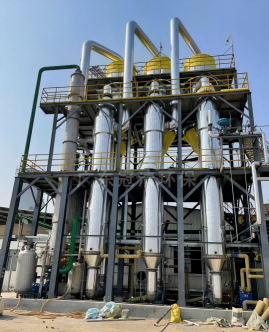
Common problems and solutions for evaporation crystallization发表时间:2025-08-15 17:44 1. How can wastewater evaporators prevent pipe blockage and scaling? Answer: There are generally two causes of pipe blockage: one is the deposition of crystallized salts; the other is scaling caused by calcium and magnesium ions. Therefore, preventing pipe blockage requires addressing these two aspects: First, choosing the right evaporation method is the first step in preventing pipe blockage. Thin-film evaporators, such as falling film evaporators, are not suitable for applications where crystals may form. If these thin-film evaporators are used in these applications, pipe blockage is inevitable. For applications prone to crystallization, forced circulation or scraped-surface evaporators should be used. Forced circulation evaporators are highly recommended due to their large evaporation area and ease of operation. They maintain a flow rate of at least 2 m/s within the heat exchange tubes. Some projects claim to be forced circulation, but the flow rate used is far from sufficient, resulting in salt deposition due to the unspecified flow rate. Second, the layout of the evaporation piping is also crucial for reducing salt buildup. Our piping design eliminates dead corners and adheres to the principles of salt flow and deposition, ensuring that all crystallized salt is collected in the salt collector and ultimately discharged through the salt outlet. If scaling is caused by calcium, magnesium, or other ions, the following measures can be taken: ① Soften the wastewater to a certain extent to reduce the concentration of calcium and magnesium ions; ② Use a forced circulation evaporator; ③ Use gypsum seeding to prevent scale or add a small amount of scale inhibitor; ④ Routinely clean the evaporation equipment. Calcium and magnesium scale can generally be removed with dilute acid. 2. Evaporator operating costs and how to reduce them? Answer: Method 1: Use a multi-effect evaporation process. Each additional effect reduces operating costs, but the initial investment increases. For wastewater salt distillation, the number of effects is generally limited to three, and at most four. Method 2: Use a thermal compression evaporator (TVR). This can reduce the energy consumption of one effect. However, system operation will become more complex. Method 3: Use a mechanical vapor compression evaporator. This reduces operating costs, but due to the immaturity of domestic steam compressors, the equipment is expensive and maintenance is more difficult. Furthermore, mechanical vapor compression evaporators are not suitable for evaporating salts and alkalis with large boiling point rises. When evaporating saline wastewater, careful consideration should be given to the use of mechanical vapor compression evaporators. Method 4: Ensure proper insulation of the evaporation equipment to minimize heat loss. Method 5: Utilize the sensible and latent heat of the condensate. Use a preheater to recover the sensible heat of the condenser and raise the feed temperature of the evaporation liquid; use a flash evaporation system to recover the latent heat of the condensate. 3. How is the salt produced by evaporation? Answer: There are generally two methods for evaporating salt: centrifuge salt extraction. Centrifuge salt has a low moisture content, but increases initial investment and operating costs. This method is suitable for those with high requirements for the quality of the evaporated wastewater. Alternatively, a salt extractor equipped with a crystallizer extracts the salt. The salt precipitates in the form of crystals, resulting in low external moisture content. The equipment is simple and easy to operate. Trace moisture can be returned to the raw liquid tank through the filter and then evaporated. 4. How should the evaporator material be selected? Answer: The choice of evaporator material is closely related to the composition of the wastewater. Salts can be divided into chloride salts (such as sodium chloride and ammonium chloride) and non-chloride salts (sodium sulfate, ammonium sulfate, sodium carbonate, nitrates, etc.). For chloride salts, the preferred order of corrosion resistance is: titanium, duplex stainless steel, carbon steel, and ordinary stainless steel. For chloride salts, the preferred order of cost-effectiveness is: carbon steel, titanium, duplex stainless steel, and least ordinary stainless steel. For non-heat exchange equipment, carbon steel enamel and PTFE are also options. For low-temperature applications, polypropylene and fiberglass are suitable. For non-chloride salts, the preferred order of corrosion resistance is: 316L stainless steel, 304 stainless steel, and carbon steel. For non-chloride salts, the preferred order of cost-effectiveness is: 304 or 316L stainless steel, followed by carbon steel. For low-temperature applications, UPVC, PE, polypropylene, and fiberglass are suitable. 5. How to choose the right evaporator? Answer: For salt evaporation, a forced circulation evaporator is preferred. If the salt concentration is low, a combination of a pre-falling film evaporator and a forced circulation evaporator can be used to reduce operating costs and initial investment. Regarding other non-salt substances... 6. What is the COD removal rate during the evaporation process? Answer: The COD content in wastewater is primarily determined by the organic matter content. Organic matter in wastewater can have either high or low boiling points. If high-boiling-point organic matter enters the solid waste and liquid waste systems along with salt during evaporation, the COD content of the condensate will decrease. However, if low-boiling-point organic matter enters the condensate system during evaporation, the COD content will not decrease. Therefore, the COD removal rate during evaporation is related to the specific composition of organic matter in the wastewater. If the construction company can provide the specific composition and content of organic matter in the wastewater, we can make a basic estimate of the COD removal rate during evaporation. The most scientific approach is to conduct a pilot evaporation test to determine the COD removal rate during evaporation. 7. Should MVR or multi-effect evaporation be used for wastewater evaporation? Answer: Both MVR and multi-effect evaporation are designed to reduce the operating costs of wastewater evaporation. The basic principle of MVR is to recompress secondary steam, increase its pressure and temperature, and reuse it to heat the heat exchanger, ultimately achieving energy savings. The basic principle of multi-effect evaporation is to heat the secondary steam in the next evaporator, achieving steam reuse. Due to various factors, the number of effects in multi-effect evaporation is often limited. From the perspective of steam conservation alone, MVR definitely saves steam consumption compared to multi-effect evaporation. Initial Cost: Compared to multi-effect evaporation, MVR requires an additional steam compressor and heat exchange area per effect, while reducing the associated equipment and condensing equipment for multi-effect evaporation. Due to the high cost of steam compressors and the increased heat exchange area, the total cost of an MVR evaporator with the same processing capacity is often three to four times that of a multi-effect evaporator. Operating Cost: MVR is suitable for evaporating liquids whose boiling point rises less with concentration, such as in the food industry, such as juice, and for evaporating low-concentration liquids (including salt solutions). In these cases, MVR offers advantages in operating costs. If the boiling point of wastewater rises rapidly with concentration, the higher the temperature required for compression, the higher the compressor power required, and the lower the economic efficiency. 8. Why is a combination of falling film evaporators and forced circulation evaporators sometimes used for brine evaporation? Answer: The main reason is to reduce operating costs and initial construction costs. Forced circulation pumps have high flow rates, complex structures, and higher construction costs. The initial construction cost of a falling film evaporator without a forced circulation pump can be reduced. Forced circulation pumps require relatively high power consumption. Removing the forced circulation pump reduces the power consumption of the evaporation system, thus reducing operating costs. Falling film evaporators are only suitable for wastewater concentration and are not suitable for applications where salt crystallization may occur. Therefore, using a falling film + forced circulation evaporator combination actually sacrifices reliability in brine evaporation. Therefore, choosing a falling film + forced circulation evaporator for treating saline wastewater requires greater caution. Generally, we only use a falling film + forced circulation evaporation combination for wastewater with a salt concentration below 10%. 9. Should triple-effect or quadruple-effect wastewater evaporation equipment be used? What are the advantages and disadvantages of each? Answer: Generally speaking, the initial construction cost of a quadruple-effect evaporator is higher, but the operating cost is relatively lower. Specifically, in the evaporation process of saline wastewater, due to the rising boiling point as concentration increases, it's inappropriate to use too many effects. Excessive effects can lead to increasingly limited energy savings, require higher raw steam pressures, and significantly increase initial construction costs. Considering both initial construction costs and operating costs, evaporators with evaporation capacities exceeding 100 tons should utilize three or four effects, while small evaporators (less than 20 tons/day) can utilize two effects. The number of effects should be determined based on the manufacturer's specific needs.
上一篇化工设计经验总结
|